

Blinded by the Demo: Why Industrial AI Demands Radar

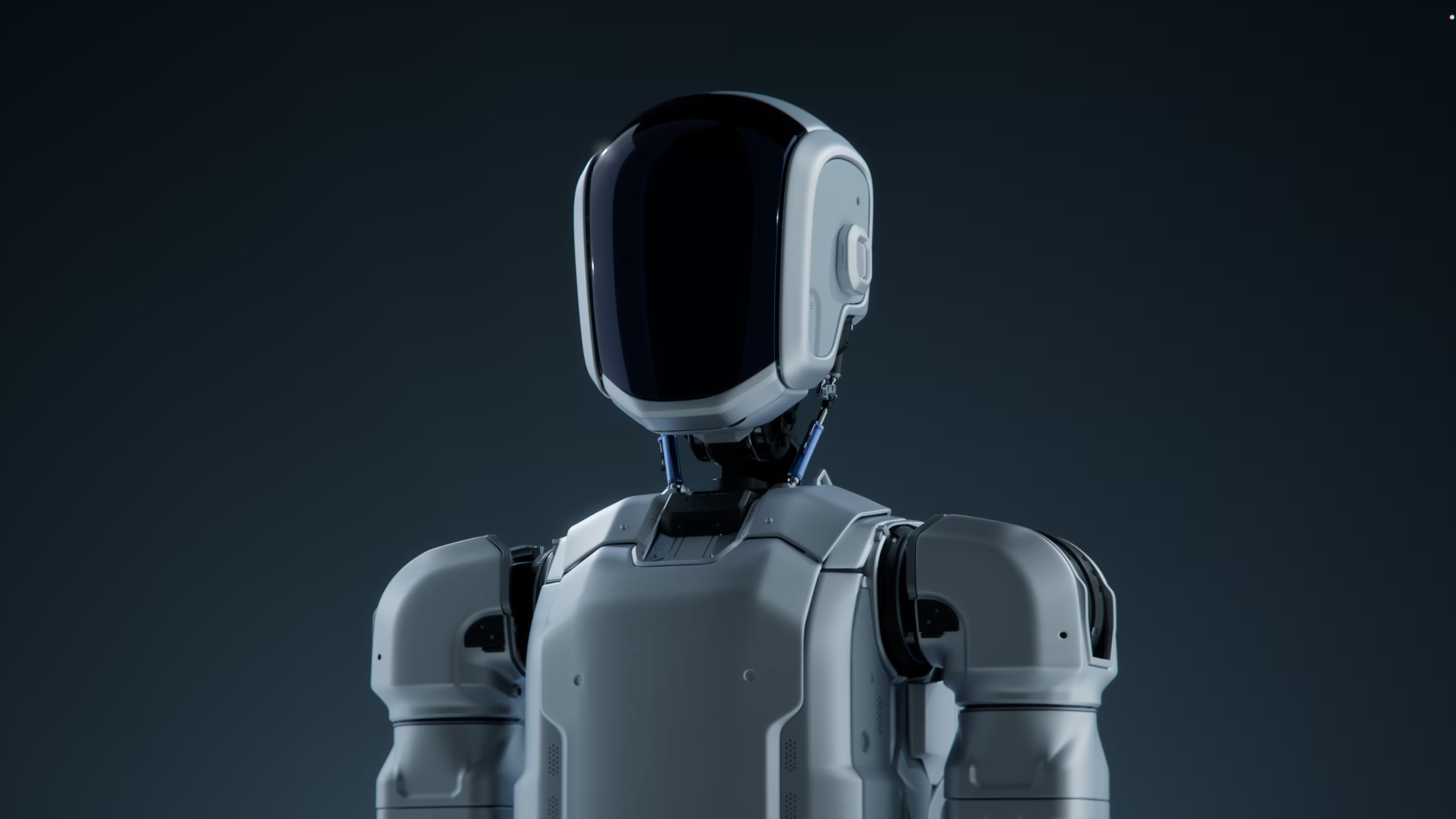
Every robotics demo looks impressive under the right lights.
On smooth concrete in a controlled facility, perception feels solved. Humanoids, Autonomous Mobile Robots (AMRs), and heavy machinery move with uncanny grace. But the moment a machine leaves the sterile conditions of a lab, operational reality sets in. Peak-shift warehouse dust rises, direct sunlight hits optical lenses, torrential rain strikes outdoor yards, and airborne grit fills mining routes. Suddenly, a perception stack designed purely around light faces a wall: it relies on an environment that refuses to stay clean or well-lit.
As robotics transitions from controlled pilot programs into full-scale industrial deployment, the central challenge is shifting. The core problem is no longer just teaching a machine to perceive under ideal conditions. It is ensuring continuous, high-uptime operation when conditions degrade.
To build physical AI that scales, perception architectures must be anchored by a sensing modality grounded in an entirely different set of physical laws: Radar.
The Operational Imperative: Why Radar is Non-Negotiable
In heavy industry, manufacturing, and logistics, downtime is the ultimate efficiency killer. When a robot’s perception confidence drops, safety architectures force it to slow to a crawl, enter a degraded state, or execute an emergency stop while awaiting human intervention. In high-throughput operations, these micro-stoppages compound into massive operational bottlenecks, directly eroding the return on investment.
Radar fundamentally eliminates this vulnerability by providing an all-weather, high-confidence perceptual anchor that optical inputs simply cannot match.
1. Penetration & Environmental Immunity
Radar operates using radio frequency (RF) wavelengths rather than visible or infrared light. Because RF waves pass cleanly through particulates and airborne obstructions, radar is inherently immune to the environmental noise that blinds optical systems. Whether operating through thick dust, dense fog, heavy smoke, sea spray, or total pitch darkness, radar maintains a clear, uncompromised view of the operational space. It does not need clean air or ambient light to deliver consistent, dependable data.
2. Direct Doppler Velocity Measurement
Understanding motion is critical for dynamic safety and obstacle avoidance. Traditional vision systems infer movement by comparing successive image frames over time, which is a process that introduces latency and computational overhead. Radar, by contrast, directly measures radial velocity instantaneously through the Doppler effect. In a single sweep, radar provides precise, real-time data on exactly how fast every target in the scene is moving relative to the machine. This instantaneous speed detection gives autonomous systems vital extra milliseconds to react to dynamic hazards.
3. The 4D Imaging Revolution
Historically, radar was viewed as a low-resolution sensor capable of little more than basic point detection. Modern 4D imaging radar has completely upended that perception. By utilizing high-channel-count MIMO (Multiple-Input Multiple-Output) antenna arrays and advanced signal processing, 4D radar delivers dense spatial point clouds with high angular resolution. It maps 3D spatial geometry (elevation, azimuth, and distance) while simultaneously locking onto the 4th dimension: instantaneous velocity. This breakthrough elevates radar from a backup safety trigger to a primary engine of continuous spatial awareness.
Radar as the Pillar of Resilient Fusion
Modern physical AI relies on deep sensor fusion, combining data streams at the raw or feature level inside neural network architectures to construct a unified representation of the world.
In a multi-modal hierarchy, every input serves a specific role:
- Semantic Understanding: Optical feeds supply visual categorization, reading labels, signage, and color-coded status indicators.
- Geometric Surface Mapping: High-density spatial sensors build detailed, fine-grained surface representations.
- Environmental Stability & Motion Detection: Radar acts as the unshakeable foundation, supplying continuous spatial tracking, dense doppler velocity, and dynamic awareness regardless of ambient atmospheric noise.
- Physical Contact: Haptic and proprioceptive sensors handle force feedback during direct manipulation.
When atmospheric noise, extreme glare, or airborne particulate degrades visual streams, deep fusion models dynamically rely on radar to maintain confidence. Because radar keeps the spatial frame stable, the system never loses situational awareness, ensuring the robot can keep moving safely.
The Business Case for Continuous Movement
Reducing perception-related interruptions is not an abstract technical preference—it translates directly into measurable economic value.
- For the Robotics Engineer: Radar provides guaranteed system confidence and deterministic safety metrics across all operating environments.
- For the Operations Manager: Radar eliminates random stopping, ensuring predictable throughput, strict schedule adherence, and minimal human intervention.
- For the Automation Investor: Radar is the critical technology that unlocks high-uptime deployment, enabling physical AI to transition from expensive pilot projects into profitable infrastructure.
The future of autonomous systems will not be defined by who builds the best perception feed under perfect conditions. It will be defined by architectures designed to maintain confidence, protect uptime, and keep moving when the real world gets messy. In that future, radar isn't just an extra hardware option. It’s the core engine of physical resilience.