

The Car Is Only Half the Story: Why True Autonomy Requires Smart Infrastructure

The autonomous vehicle industry has spent over a decade — and hundreds of billions of dollars — perfecting what happens inside the car. Sensor stacks. Compute platforms. AI perception models. Simulation frameworks. Over-the-air updates. And the results are real: today's most advanced AVs can navigate complex urban environments with a level of situational awareness that would have seemed impossible a generation ago.
But here is the uncomfortable truth that most of the industry quietly acknowledges and rarely says out loud: the car being ready is not enough.
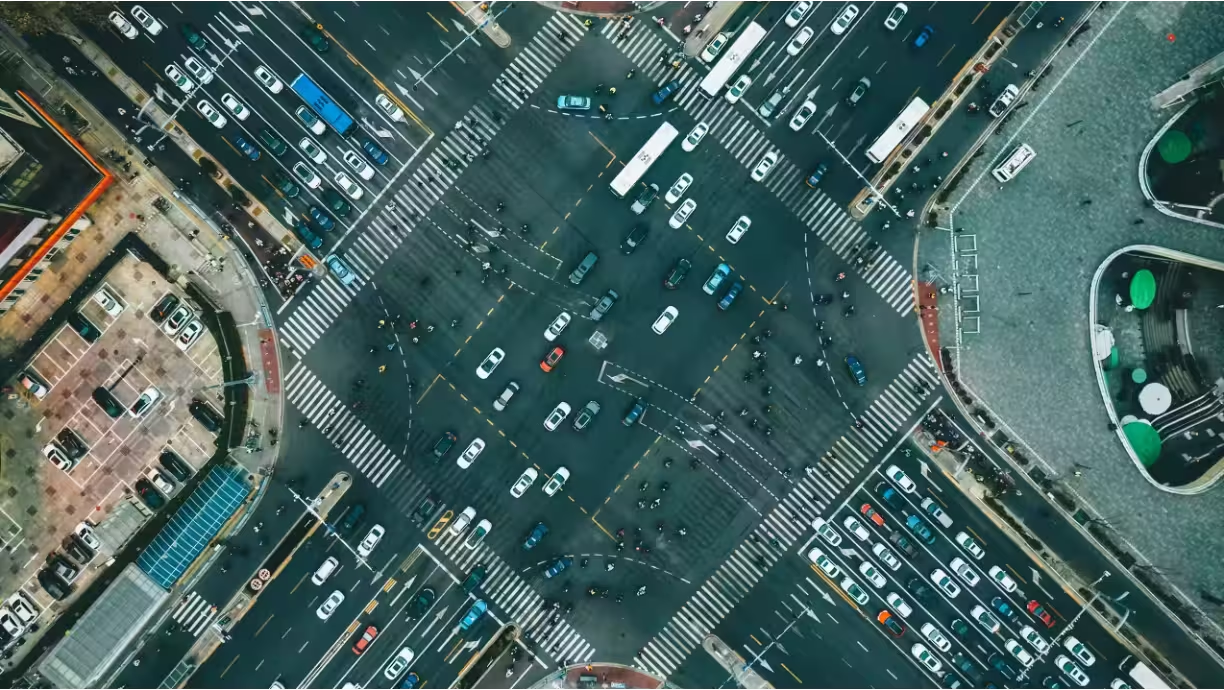
Autonomous vehicles do not operate in a vacuum. They operate on roads. At intersections. In cities. Alongside pedestrians, cyclists, delivery robots, and human drivers who have absolutely no idea what the AV next to them is about to do. And the vast majority of that environment — the roads, the signals, the intersections — is still completely dumb.
That asymmetry is one of the biggest unspoken barriers to true autonomy at scale. And closing it requires a shift in how the industry thinks about where the intelligence actually needs to live.
What an AV Can See — and What It Cannot
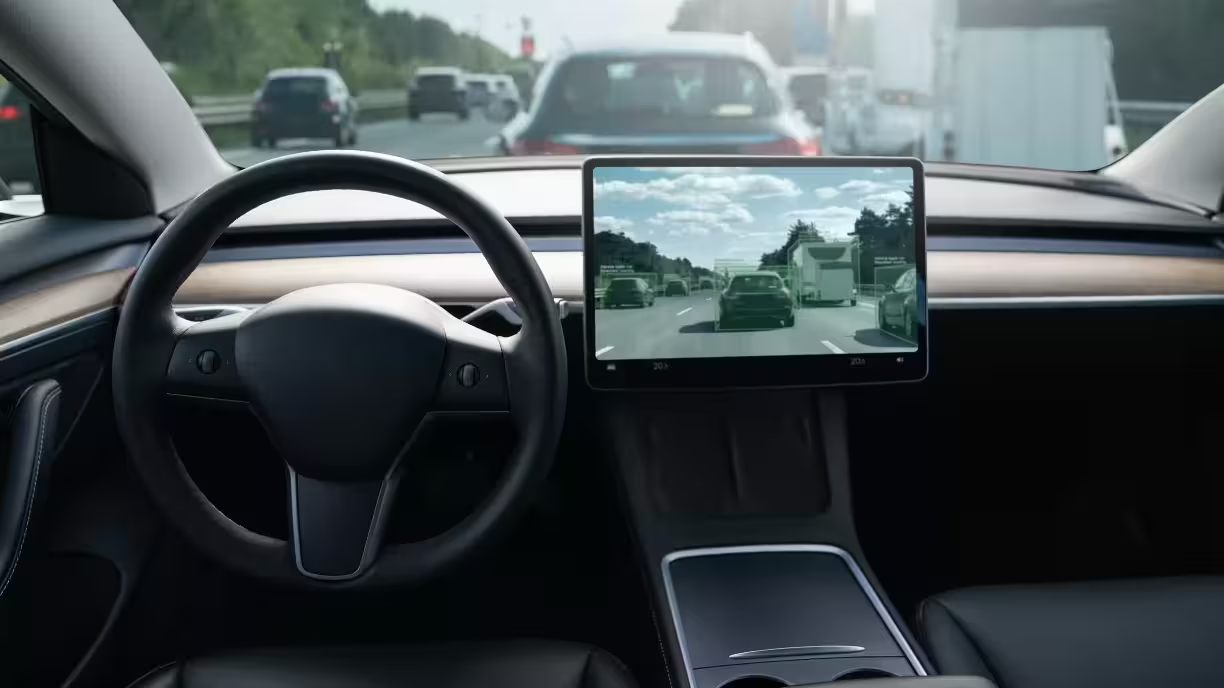
Modern 4D imaging radar, like bitsensing's AIR4D, represents a genuine leap in what onboard sensors can perceive. Unlike traditional radar, 4D imaging radar adds elevation data to range, azimuth, and velocity — giving an autonomous vehicle a real-time, high-resolution spatial picture of its environment across all four dimensions. It detects objects up to 300 meters away, performs in near-total darkness, and cuts through rain, fog, and snow that would blind a camera. Combined with a radar-camera fusion architecture, it delivers the kind of perception fidelity that safe autonomous driving genuinely demands.
That is powerful. But even the most capable onboard sensor system has a hard physical limit: it can only see what is within its line of sight.
An AV approaching a busy urban intersection cannot see the pedestrian stepping off the curb on the far side of a delivery truck. It cannot see the vehicle running a red light two seconds before it enters the junction. It cannot know that a road incident 400 meters ahead has brought traffic to a standstill around the next bend. No matter how advanced the onboard sensor suite becomes, the laws of physics mean there will always be information the vehicle simply cannot access from its own vantage point.
This is not a sensor problem. It is an architecture problem. And the solution is not a better sensor in the car — it is intelligence built into the road itself.
The Road Needs to Become a Sensor
Imagine the same 4D radar perception capability that lives inside an AV — mounted at an intersection, looking in all directions simultaneously, with no blind spots, no occlusions, and no single vehicle's limited perspective. That infrastructure sensor sees everything. It tracks every vehicle, every pedestrian, every cyclist entering the junction from every approach. It calculates speeds, trajectories, and conflict points in real time. And critically, it can share that information — with the AV approaching the intersection, with the traffic signal management system, with the city's traffic operations center.
This is not a theoretical concept. bitsensing's TIMOS (Traffic Insight Monitoring Sensor) is already doing exactly this in cities across South Korea, in Daegu, Wonju, Jeju-do, and Seongnam-si, as well as internationally including India and Italy. TIMOS detects up to 256 vehicles simultaneously across eight lanes, operates in all weather conditions, and uses edge AI to identify risk events — wrong-way drivers, jaywalking, intersection blockages — before they become accidents.
But detecting events is only the first step. Acting on them — and doing so across an entire city, not just a single intersection — is where TraXight comes in. TraXight is bitsensing's server-based traffic intelligence platform that aggregates data from multiple roadside sensors in real time, enabling cities to analyze intersection throughput, identify bottlenecks, and diagnose systemic traffic problems at scale. Where TIMOS gives a single intersection its eyes, TraXight gives the city its brain — connecting the dots between what individual sensors see and what urban planners and AV operators actually need to make decisions. For an autonomous vehicle fleet operating across a city, that kind of networked intelligence is not a nice-to-have. It is the operational backbone that makes city-scale autonomous deployment viable.
The point is not to promote a product. The point is to illustrate what becomes possible when the road itself starts to perceive and think. When infrastructure becomes a sensor — and when that sensor data flows into a living, real-time picture of the city — AVs are no longer operating with one eye closed.
V2X: When the Road Talks to the Car
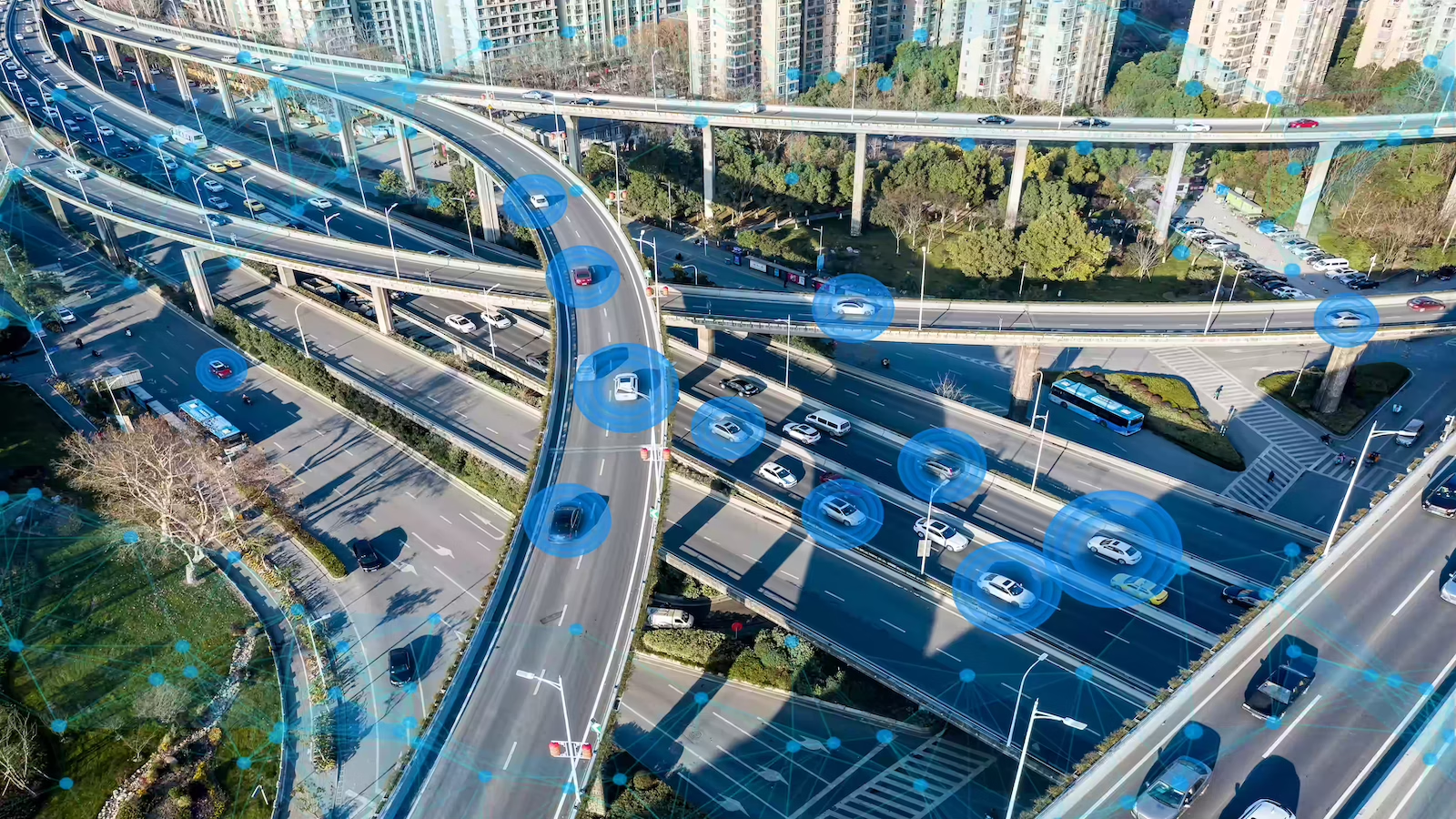
Smart sensing infrastructure is necessary but not sufficient on its own. For that roadside intelligence to genuinely help an AV make better decisions, the two need to communicate. This is the promise of Vehicle-to-Everything (V2X) technology — a communication layer that allows vehicles to exchange real-time data with infrastructure, with other vehicles, and with traffic management systems.
When a smart intersection equipped with radar sensing detects a hazard and broadcasts that information to approaching vehicles via V2X, the AV does not need to see the hazard directly. It receives the intelligence from the infrastructure and reacts accordingly — earlier, more confidently, and with more information than its onboard sensors alone could provide.
This cooperative model of perception — where the vehicle and the infrastructure share their views of the world — fundamentally changes what Level 4 and Level 5 autonomy can look like in practice. It means autonomy is no longer a property of the vehicle alone. It becomes a property of the system: vehicle, road, and city working in concert.
Why This Matters for Business Leaders
For executives in automotive, mobility, logistics, and urban development, this has significant strategic implications that go beyond the technology itself.
The AV deployment timeline is an infrastructure problem as much as a technology problem. Every AV program currently facing delays in commercialization is contending, at least in part, with the reality that the roads they need to operate on were not designed for autonomous vehicles. Addressing that gap requires investment not just in the vehicles but in the environments where those vehicles will operate.
Cities that invest in smart infrastructure will attract AV deployment faster. Autonomous vehicle operators evaluating where to launch commercial services will prioritize geographies where the road environment reduces operational risk. A city with smart intersections, radar-equipped road infrastructure, and V2X capability is a fundamentally more attractive deployment environment than one without it. Infrastructure investment is a competitive advantage at the city level.
The sensor supply chain for infrastructure is maturing in parallel with the automotive sensor market. The same technology advances that have made high-performance 4D imaging radar viable for AVs are making it viable for roadside deployment at scale — smaller form factors, lower power consumption, lower cost, and higher reliability. The infrastructure buildout that autonomy requires is not a distant aspiration; the enabling technology exists today.
The Full Picture
The autonomous vehicle industry has built something remarkable. The onboard technology — 4D imaging radar, sensor fusion, AI perception — has advanced at a pace few would have predicted a decade ago. bitsensing's AIR4D represents what is now achievable: an open-architecture 4D radar purpose-built for autonomous vehicles, delivering raw point cloud and Doppler data that AV developers can use to continuously refine their perception models and accelerate the path to commercial fleet deployment.
But the vehicles and the roads are part of the same system. An AV without smart infrastructure is like a smartphone without a network — capable in isolation, but a fraction of what it becomes when connected to the broader environment it was designed to operate in.
True autonomy is not a vehicle achievement. It is a systems achievement — one that requires the car and the city to become intelligent together.
The industry has been focused on the car. It is time to focus on the road.
bitsensing builds radar solutions for autonomous vehicles and smart infrastructure. AIR4D is bitsensing's 4D imaging radar for autonomous vehicle perception. TIMOS and TraXight are bitsensing's intelligent traffic sensing and management solutions deployed in cities across Korea,Asia, and Europe.