

From Protection to Prevention: How Vehicle Safety Is Changing


For much of automotive history, safety was defined by what happened during a crash.
Seatbelts, airbags, and stronger vehicle structures were built to protect occupants once impact became unavoidable.These systems transformed road safety and remain essential today. But the definition of safety is evolving. Increasingly, safety is no longer judged only by how well a vehicle protects people after danger arrives. It is judged by how effectively a vehicle can recognize risk early enough to reduce or avoid harm altogether.
This is the shift from reaction to prediction.
The Legacy of Reactive Safety
Reactive safety was built around a simple truth: human error is inevitable.
For decades, the industry focused on minimizing injury when crashes occurred. Crumple zones absorbed energy. Airbags reduced trauma. Seatbelts improved survivability. In many ways, this approach defined modern vehicle engineering.
That logic still matters. The World Health Organization estimates that around 1.19 million people are killed inroad crashes each year, with road traffic injuries remaining the leading cause of death for children and young adults aged 5 to 29. [1] In the U.S., NHTSA’s final 2024 data recorded 39,254 traffic fatalities — a slight improvement over 2023’s 40,990, yet still a devastating toll. [2]
But reactive safety has a built-in limit: it begins after a situation has already failed.

Why Prevention Is Becoming the New Standard
Modern mobility is raising the standard.
Today’s expectation is not simply that a vehicle should protect people in a collision. It is that the vehicle should increasingly help prevent the collision from happening in the first place. This shift is visible not only in technology roadmaps, but also in how regulators and safety programs now evaluate vehicles.
In November 2024, NHTSA finalized a new NCAP ADAS roadmap that adds four technologies to the program: blind spot warning, blind spot intervention, lane keeping support, and pedestrian automatic emergency braking. [3] That change signals clearly how safety assessment is moving upstream — toward sensing, awareness, and intervention before impact.
A similar direction is visible in Europe. Euro NCAP’s Vision 2030 outlines a broader view of safety that goes beyond crashworthiness to include driver monitoring, child presence detection, vulnerable road user protection, and more proactive sensing capabilities. Critically, Euro NCAP has stated that from 2025 onward, only direct sensing systems capable of effectively detecting a living being will be rewarded for child presence detection. [4]
Together, these changes reflect a new reality: safety is no longer just about surviving impact. It is about identifying risk sooner, more reliably, and in a wider range of real-world conditions.
Prediction Depends on Awareness
A vehicle cannot avoid what it cannot understand.
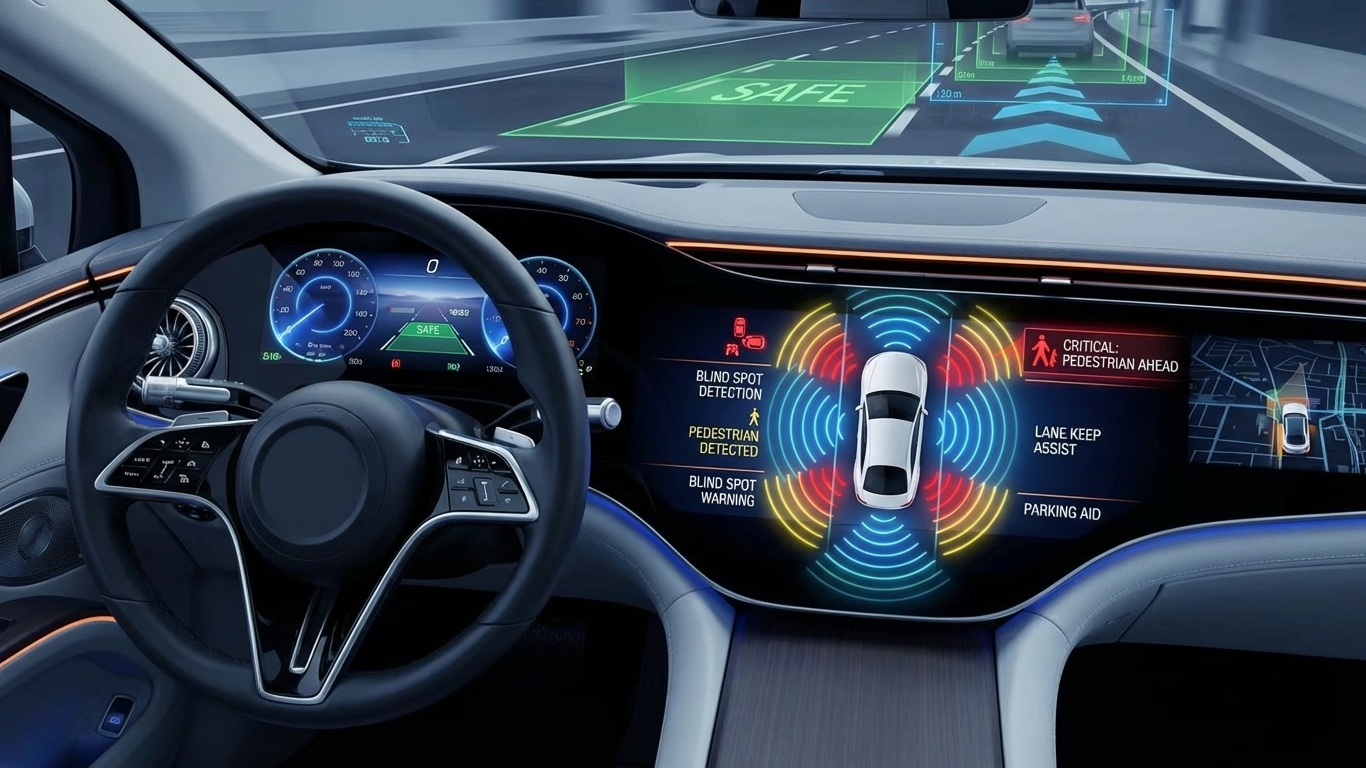
Predictive safety begins with continuous awareness of the environment: where objects are, how fast they are moving, whether a pedestrian may cross unexpectedly, whether a driver is distracted, or whether road conditions are changing faster than a human can react.
This is why sensing has become central to modern safety. Cameras help interpret lanes, signs, and object categories. Radar adds reliable distance, speed, and motion data — including in conditions where visibility is reduced. The shift toward prevention is not only about adding software features. It is about giving vehicles a stronger ability to observe the world before a critical moment develops.
This matters because real roads are rarely ideal. Safety systems are increasingly expected to work not only on clear days and well-marked highways, but also at night, in rain, at intersections, and in dense urban traffic. IIHS notes that its pedestrian front crash prevention tests include nighttime scenarios — and radar-based systems are not affected by light levels in the same way cameras are.[5] This is a meaningful distinction in real-world performance.
Approximately 94% of road accidents stem from human error. [6] ADAS is specifically designed to close that gap —automating the awareness and response that human perception sometimes fails to provide in time.
The Data Already Points in This Direction
The move toward preventive safety is not just conceptual. It is supported by real-world results.
IIHS research shows:
• Front crash prevention with automatic braking reduces police-reported rear-end crashes by approximately 40%, while forward collision warning alone cuts them by 23% [7]
• Pedestrian-recognizing automatic braking systems reduce pedestrian crashes by 27% [7]
• A 2024 IIHS-HLDI study found front-to-rear crash rates were 49% lower for Nissan Rogues equipped with forward collision warning and AEB versus those without [7]
A 2025 peer-reviewed analysis published in ScienceDirect synthesized real-world effectiveness data across 28 ADAS features and found:
• Lane Keeping Assist (LKA): crash rate reduction of 19.1% [8]
• Driver Monitoring Systems (DMS): crash rate reduction of 14% [8]
• Blind Spot Monitoring: lane-change crashes reduced by 14%, and lane-change crash injuries by 23% [6]
Looking further ahead, a study by the AAA Foundation for Traffic Safety projects that ADAS technologies could help avoid an estimated 249,400 fatalities and 14.1 million nonfatal injuries between 2021 and 2050 — representing 22% of all deaths that would otherwise occur on U.S. roads during that period.[9]
These numbers matter because they show what the future of safety looks like in practice. The most valuable intervention is often not the one that protects occupants during a crash. It is the one that prevents the crash, reduces the closing speed, or buys the extra second that changes the outcome.

From Vehicle Feature to System-Level Safety
Another important change is that prediction is no longer confined to the vehicle alone.
Safety is increasingly becoming a system-level capability that includes the vehicle, the driver, roadside infrastructure, and the broader traffic environment. Euro NCAP’s future vision explicitly expands attention toward occupant state monitoring and vulnerable road users, while public-sector road safety efforts increasingly emphasize evidence-based, coordinated approaches across the mobility ecosystem.
This means that the next generation of safety will depend not only on stronger vehicles, but also on better situational awareness across roads, intersections, and public spaces. In that environment, sensing becomes more than a component. It becomes part of the infrastructure of prevention.
Why This Matters for the Future of Mobility
The broader significance of this shift is simple: safety expectations are rising.
By 2028, the Highway Loss Data Institute projects that approximately 55% of registered vehicles in the U.S. will have front crash prevention, 53% will have blind spot monitoring, and 52% will have lane departure warning. [9] These systems are becoming baseline expectations, not premium options.
It is no longer enough for a vehicle to respond after a threat becomes obvious. Modern mobility increasingly demands earlier detection, faster interpretation, and more reliable intervention. As ADAS capabilities become more common and safety protocols grow more demanding, the industry is moving toward a future where prediction is not an advanced feature. It is becoming a baseline expectation.
For companies building the sensing technologies behind next-generation mobility, this changes the question entirely. The challenge is no longer just how to detect an object. It is how to support timely, dependable decisions in the messy, variable conditions of the real world.
Conclusion: Safety Starts Before Impact
Protection will always matter. Seatbelts and airbags will remain essential because risk can never be fully eliminated.
But the center of gravity is shifting.
The new era of vehicle safety begins earlier — before impact, before loss of control, before a missed warning becomes an emergency. It begins with the ability to detect patterns of risk, understand them quickly, and act in time.
This is the move from protection to prevention.
And as mobility becomes more intelligent, the systems that matter most will not simply react to danger well. They will recognize it early enough to change what happens next.
FAQ
Q: What does ADAS stand for, and what does it do?
ADAS stands for Advanced Driver Assistance Systems. These are technologies built into vehicles to help drivers recognize and respond to potential hazards — including automatic emergency braking, lane keeping assist, blind spot monitoring, and driver attention detection. The goal of ADAS is to reduce accidents by closing the gap created by human error.
Q: Why is radar important for ADAS?
Radar provides reliable detection of distance, speed, and movement in all weather and lighting conditions —including rain, fog, and complete darkness. Unlike cameras, radar does not depend on visibility. This makes it particularly valuable for nighttime scenarios and adverse conditions where camera-based systems may underperform.
Q: How effective is ADAS at preventing crashes?
Real-world data is compelling. IIHS research shows front crash prevention with AEB reduces rear-end crashes by around 40%. Pedestrian AEB reduces pedestrian crashes by 27%. Lane Keeping Assist reduces crash rates by 19.1%, according to a 2025 ScienceDirect analysis. The AAA Foundation projects ADAS could prevent 249,400 fatalities and 14.1 million injuries between 2021 and 2050.
Q: What is the difference between reactive and predictive safety?
Reactive safety systems — like seatbelts and airbags — protect occupants after a crash occurs. Predictive safety systems, including ADAS features, aim to detect and respond to risk before acrash happens. The industry is shifting toward prediction because it offers the opportunity to prevent harm entirely, rather than simply mitigating it.
Q: What are regulators doing to encourage ADAS adoption?
NHTSA updated its NCAP safety program in November 2024 to formally include blind spot warning, blind spot intervention, lane keeping support, and pedestrian AEB as evaluation criteria. In Europe, Euro NCAP's Vision 2030 requires direct sensing systems for child presence detection from 2025 onward. These moves signal that prevention-focused safetyis now a regulatory expectation, not just a differentiator.
Q: What does bitsensing offer for automotive safety?
bitsensing develops radar-based sensing solutions for automotive and mobility applications. Our products include 4D Imaging Radar for high-resolution perception, front and corner radars for blind spot and cross-traffic detection, in-cabin radar for occupant monitoring including child presence detection, and the ADAS Kit — a ready-to-deploy radar and camera fusion system for next-generation driver assistance.
Reference
[4] Euro NCAP (2024): "Vision 2030" — direct sensing mandate for child presence detection from 2025.